
congstar Home 150 Flex
FibreOfferFlexibleUnlimited150 Mbps · 75 up · Unlimited · Flexible · setup €0.00
More about congstar€36.00/ month
To congstarTransparency

HomeInternet typesFibre
If you want fibre internet in Germany, the decisive question is whether FTTH reaches your exact home—not merely your town or street. Where it is available, fibre can provide fast downloads, substantial upload capacity and a stable fixed connection. We reviewed 20 residential fibre plans from five providers, including flexible and 24-month options. Before choosing one, compare the full contract cost and confirm that your building and flat can actually be connected.
Showing 20 of 20 plans · Prices last checked 2 October 2026
150 Mbps · 75 up · Unlimited · Flexible · setup €0.00
More about congstar€36.00/ month
To congstar300 Mbps · 150 up · Unlimited · Flexible · setup €0.00
More about congstar€42.00/ month
To congstar600 Mbps · 300 up · Unlimited · Flexible · setup €0.00
More about congstar€50.00/ month
To congstar1,000 Mbps · 500 up · Unlimited · Flexible · setup €0.00
More about congstar€65.00/ month
To congstar
150 Mbps · 75 up · Unlimited · 24 mo · then €39.99 from month 13 · setup €9.99
More about O2€24.99/ month
To O2
100 Mbps · 50 up · Unlimited · 24 mo · then €39.99 from month 13 · setup €79.99
More about Deutsche Glasfaser€29.99/ month
To Deutsche Glasfaser300 Mbps · 150 up · Unlimited · 24 mo · then €49.99 from month 13 · setup €79.99
More about Deutsche Glasfaser€29.99/ month
To Deutsche Glasfaser1,000 Mbps · 500 up · Unlimited · 24 mo · then €89.99 from month 13 · setup €79.99
More about Deutsche Glasfaser€29.99/ month
To Deutsche Glasfaser500 Mbps · 250 up · Unlimited · 24 mo · then €69.99 from month 13 · setup €79.99
More about Deutsche Glasfaser€29.99/ month
To Deutsche Glasfaser300 Mbps · 150 up · Unlimited · 24 mo · then €44.99 from month 13 · setup €9.99
More about O2€29.99/ month
To O2
150 Mbps · 75 up · Unlimited · 24 mo · setup €49.95
More about 1&1€44.99/ month
To 1&1600 Mbps · 300 up · Unlimited · 24 mo · then €59.99 from month 13 · setup €9.99
More about O2€44.99/ month
To O2
€47.95/ month
To Telekom300 Mbps · 150 up · Unlimited · 24 mo · setup €49.95
More about 1&1€49.99/ month
To 1&1€52.95/ month
To Telekom1,000 Mbps · 500 up · Unlimited · 24 mo · then €69.99 from month 13 · setup €9.99
More about O2€54.99/ month
To O2600 Mbps · 300 up · Unlimited · 24 mo · setup €49.95
More about 1&1€59.99/ month
To 1&1€62.95/ month
To Telekom1,000 Mbps · Up — · Unlimited · 24 mo · setup €49.95
More about 1&1€69.99/ month
To 1&1€72.95/ month
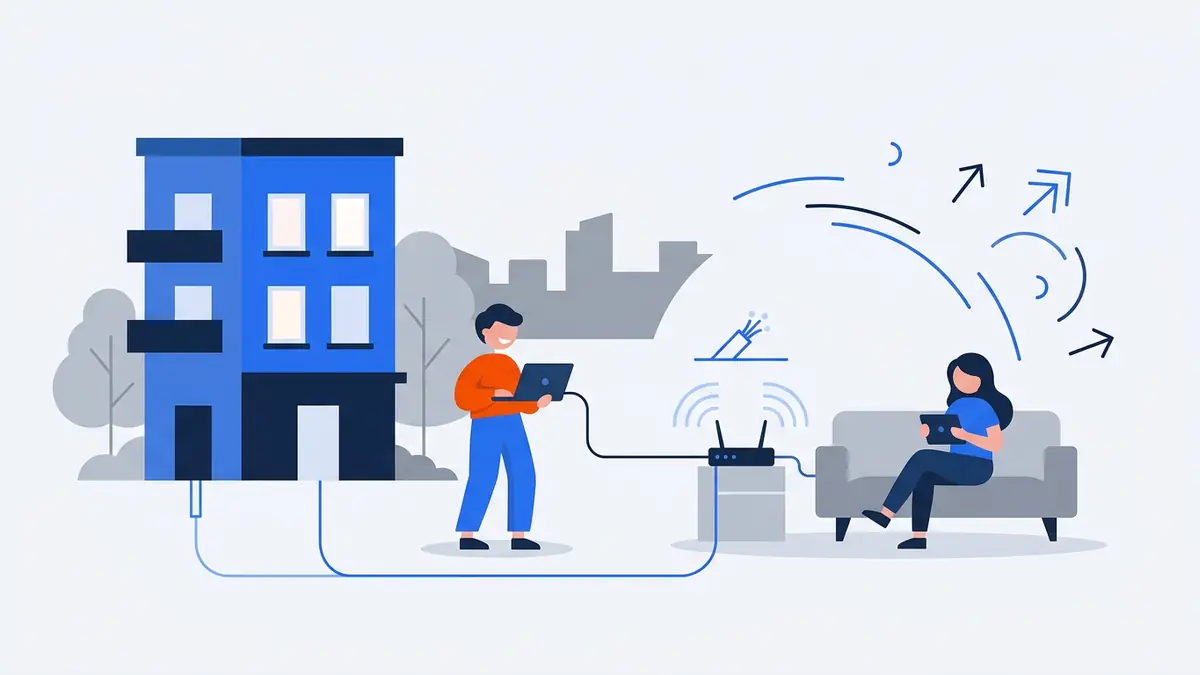
To TelekomFibre-to-the-home, or FTTH, carries data through fibre-optic cable all the way to your premises. This distinguishes it from connections that use fibre for part of the route but rely on copper or coaxial cable for the final section.
Inside the home, the fibre normally terminates at a fibre connection point. An optical network terminal or compatible router converts the optical signal so your devices can connect by Wi-Fi or Ethernet. The provider should explain which equipment is required and whether it is supplied.
Availability is building-specific. A street may have fibre infrastructure while an individual property, entrance or flat still needs approval or installation work. That is why FTTH Germany availability cannot be established from a postcode alone. You need to enter the complete address and, where requested, the floor or unit.
The published residential plans we reviewed come from congstar, Telekom, O2, 1&1 and Deutsche Glasfaser. Each offers several speed levels, but an address may qualify for only some providers or products.
The contract structures differ. The reviewed congstar plans have flexible terms and no included German landline. The reviewed Telekom, O2 and 1&1 fibre plans run for 24 months and include a German landline. Deutsche Glasfaser also uses 24-month terms; its DG basic 100 plan does not include a landline, while the other reviewed plans do.
Provider choice should therefore follow the address check rather than precede it.
Separate the recurring price from one-off costs. The reviewed congstar plans have a €0 activation fee, while the reviewed O2 plans charge €9.99. The published activation fee is €49.95 for the reviewed 1&1 plans and €79.99 for the reviewed Deutsche Glasfaser plans.
We could not verify an activation fee for the reviewed Telekom plans, so confirm it directly before ordering. You should also ask whether the quoted amount includes the router, fibre termination equipment, technician work and any connection work required inside or outside the building.
For promotional offers, calculate the cost across the full minimum term rather than comparing only the first monthly payment.
Read the contract summary and confirm the details that affect your total cost and installation:
Upload speed deserves attention if you regularly send large files, use cloud backups or make video calls. For a broader explanation of choosing a suitable connection, see our guide to internet speed in Germany. If you are arranging service after a move, follow the practical steps for getting internet in Germany.
Fibre runs an optical connection directly to the premises and is particularly attractive when you want substantial upload capacity or expect several people to use the connection heavily. Its main practical limitation is address-specific availability and the possibility that a property still needs installation work.
DSL internet uses the telephone line for the final connection and may be an option where FTTH is not ready. Cable internet uses the building’s coaxial cable network and can offer fast downloads, but performance is shaped by the local network and property connection. 5G home internet uses a mobile signal, so indoor reception and local network conditions matter.
Compare only technologies that pass the address check. A slower plan on an installed fixed line may be more practical than waiting for fibre construction, while an available FTTH connection may suit a household that values higher upload speeds and a long-term fixed connection.
Confirm the live offer at your address.
You must check the complete address with individual providers. Fibre availability can differ between neighbouring buildings and even between units in the same development. Enter the street, house number, postcode and any requested unit details. Confirm that the result identifies FTTH or fibre, then check whether installation, property-owner approval or access to shared building areas is still required.
FTTH means fibre-to-the-home. The fibre-optic cable runs directly to the premises rather than switching to telephone or coaxial cable for the final section. In Germany, you may see the service described as Glasfaser. The connection normally needs a fibre termination point and optical network equipment before your router can provide Wi-Fi or wired access.
Prices depend on the provider, speed, contract structure and address. Among the plans we reviewed, some have introductory prices that rise from month 13, while others use a published monthly list price. Activation fees also differ. Compare the cost across the full minimum term and confirm equipment, technician and property-connection charges directly with the provider.
You may need approval if installation requires changes to the building, access to shared areas or new cabling into your flat. The provider can explain the planned work, but your landlord or property manager may need to authorise it. Ask who coordinates the appointment and whether the building already has a usable fibre connection before signing the contract.
Fibre is attractive for its high download and upload capacity and direct optical connection, but it is only useful if your home can be connected on acceptable terms. DSL may be easier to obtain through an existing telephone line, while cable uses coaxial infrastructure in the building. Compare actual address availability, upload speed, contract cost and installation requirements rather than technology names alone.